How I Found Out I Have Aphantasia
I learned my mind was different the way most people with aphantasia do: by accident, in a normal conversation, from a friend describing something I assumed was a figure of speech.
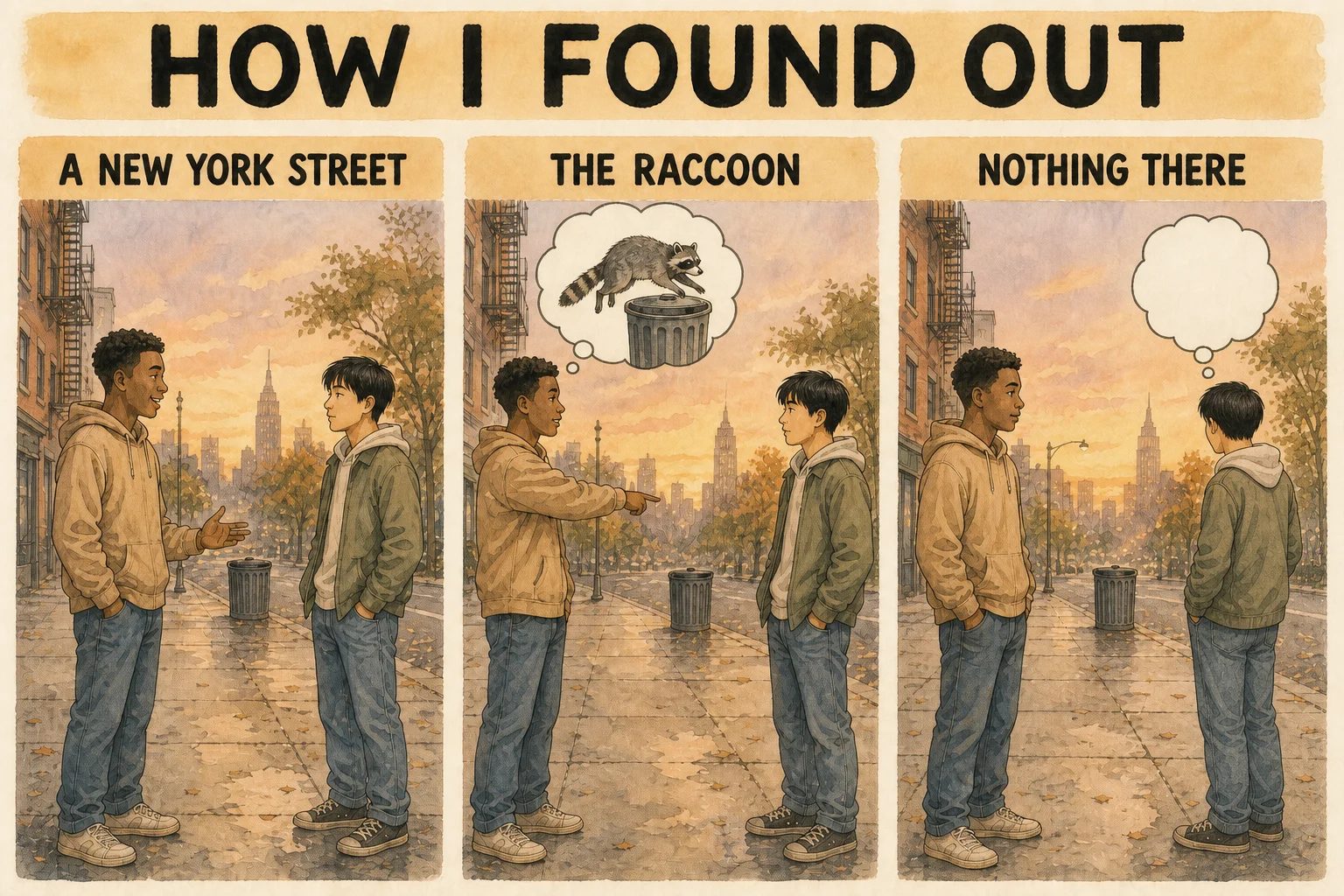
A street in New York
It was 2016 or 2017. I was in New York with my friend Yinka, and we were talking about focus: why I could lock onto one thing for hours while other people seemed to be pulled in ten directions at once.
Yinka was honest with me. He said he thinks about sex a lot. I asked him how that even works. How do you think about sex? He was baffled by the question. I told him the truth: I cannot picture it, so there is nothing there for my mind to return to. It just does not pull on me.
Then he said the thing that broke my model of other people. He said that sometimes his mind produces pictures on its own, without asking permission.
We were looking out at the street. He pointed at a trash can and said, "I can picture an imaginary raccoon jumping into that trash can right now."
I asked him what he meant. Literally see it?
Yes. Literally see it.
Nothing on the screen
That blew my mind. I had always assumed that "picture this" and "imagine a beach" were expressions, the way "I'm starving" is an expression. I thought everyone was doing what I do, which is holding the idea of a beach. I know a beach has sand and water and warmth. I can tell you all about it. But when I close my eyes, there is no beach. There is nothing. No color, no shape, no raccoon.
It had never occurred to me that my mental hardware could be that different from a close friend's, and it had never occurred to him either.
Finding the word
I went down the rabbit hole. By April 2020 my journal had a one-line entry that still makes me smile: "I have aphantasia. That explains a lot."
It did explain a lot. Why I could not memorize a speech. Why I forget what people were wearing. Why I can live somewhere for years and not be able to describe the apartment. Why I move on from things so quickly. Six months later I wrote a second entry after binging the latest science: "Aphantasia is a superpower."
I also learned I do not have an inner monologue. There is no voice in my head narrating my day. More on both in What It Is Like.
Then I started asking everyone
Once I knew my own brain was unusual, I could not stop asking other people how theirs worked. Can you see your memories? Can you rotate them? Can you hear a song in your head? Do you have one inner voice or several, and do they argue?
The answers were wildly different, person to person, even among people who had known each other for decades. I collected nearly 200 questions and eventually cut them down to 101 for a card game called Our Magic Within. Around 2022 it became a hit among my friends, because every round revealed something about someone you thought you already knew. Many of those questions live on in Questions to Ask the People You Love.
What I believe about it now
Back then I was fascinated by neurodiversity as a scientist would be. Now, as a follower of Christ, I see it differently. I see just how differently God made each of our minds, and I think the difference is on purpose. We are made to depend on each other. The person who can see the raccoon and the person who cannot need each other. That idea is the heart of An Ode to Neurodiversity.
Further Reading
- What It Is Like: the inside view, the gifts and the costs.
- Moving On: why I do not dwell in the past.
- Where the Word Came From: aphantasia was only named in 2015.
- You Are Not Broken: for anyone who just found out.