People With Aphantasia
If you think a mind without pictures cannot create, look at who has one.
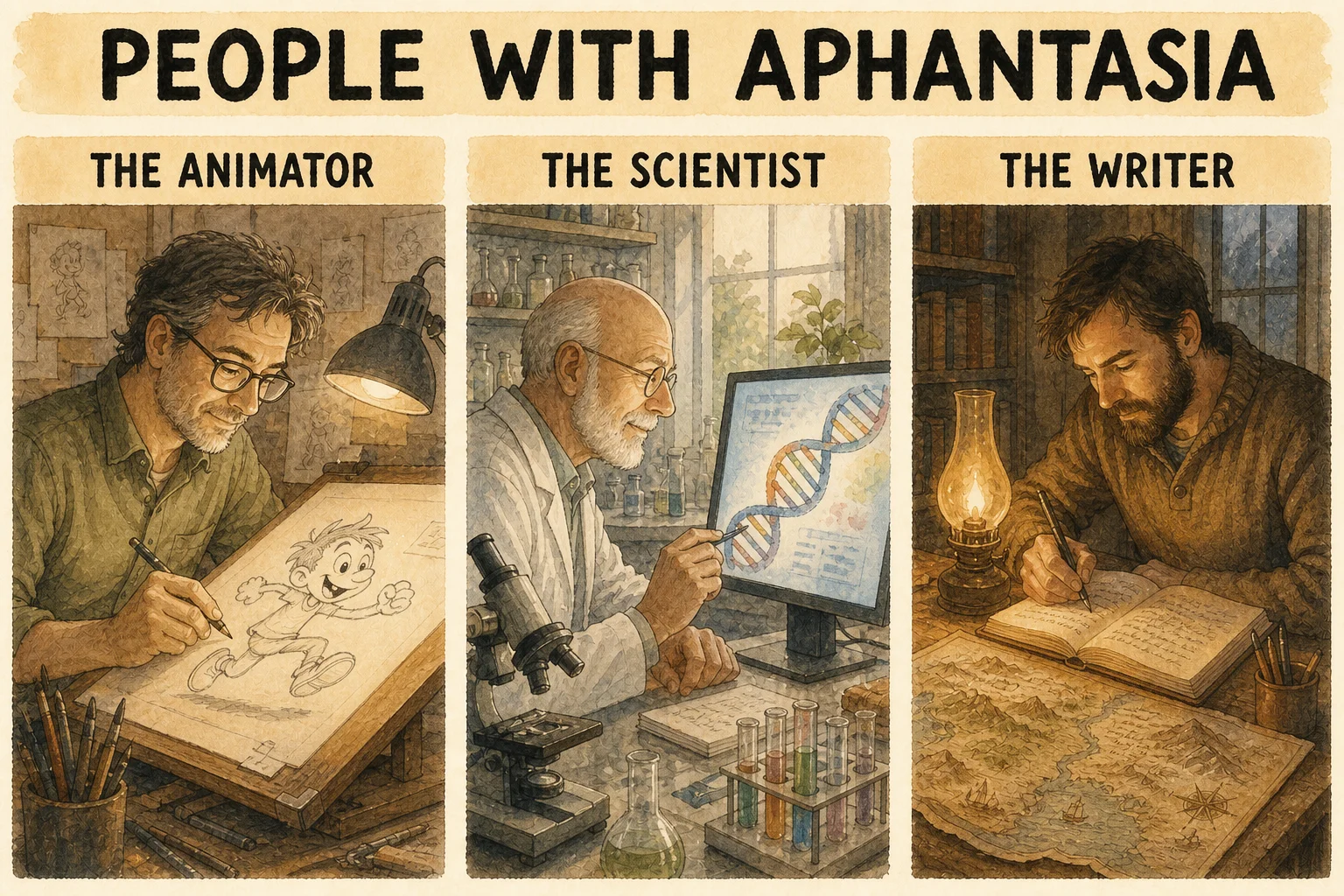
Why this list matters
When people first learn they have aphantasia, a common fear is that it means they are not creative, or not imaginative, or limited in what they can do. The people below have spoken publicly about having no mind's eye. Every one of them is a reminder that imagination and creativity are not the same thing as seeing pictures.
This list only includes people who have described it themselves in a credible, public source.
Creators
- Ed Catmull, co-founder and former president of Pixar. He discovered it while trying to picture a sphere during meditation. His conclusion: people "had conflated visualisation with creativity and imagination," and "they're not the same thing." (BBC News, 2019)
- Glen Keane, the Disney animator behind Ariel in The Little Mermaid and the Beast. The same BBC report notes that he also has no visual imagery. (BBC News, 2019)
- Mark Lawrence, bestselling fantasy novelist. He writes vivid fantasy worlds without seeing any of them in his head, and has written about what that is like. (Mark Lawrence's blog)
- John Green, author of The Fault in Our Stars. On seeing the apple scale, he wrote: "It's baffling to me that some of y'all see stuff in your mind. You SEE it?" (John Green on X, 2023)
Builders and scientists
- Blake Ross, co-creator of the Firefox web browser. His 2016 essay introduced aphantasia to millions: "nearly all of you have a canvas. I don't." (Refinery29 coverage, 2016)
- Craig Venter, the genome scientist whose team sequenced a human genome. "I have found as a scientific leader that aphantasia helps greatly to assimilate complex information into new ideas and approaches." (University of Exeter, 2020)
Leaders and advocates
- Dame Gill Morgan, a former senior leader in the UK's National Health Service. "I had no idea what a sunrise looked like. I know it when I see it... but I couldn't imagine it at all." (BBC Science Focus)
- Tom Ebeyer, co-founder of the Aphantasia Network and one of the 21 participants in the 2015 study that named aphantasia. He helped turn a discovery into a community. (Aphantasia Network)
What they have in common
Look at the pattern. An animation studio built on imagination. A beloved animated princess. Whole fantasy worlds. A web browser. A sequenced genome. None of it needed a picture in someone's head. It needed curiosity, feeling, conviction, and a lot of work, often with other people whose minds worked differently.
That last part matters most to me. Catmull did not build Pixar alone, and none of us build anything alone. See An Ode to Neurodiversity.