The Spectrum
Imagination runs along a range, from nothing to vivid, and across every sense, not just sight.
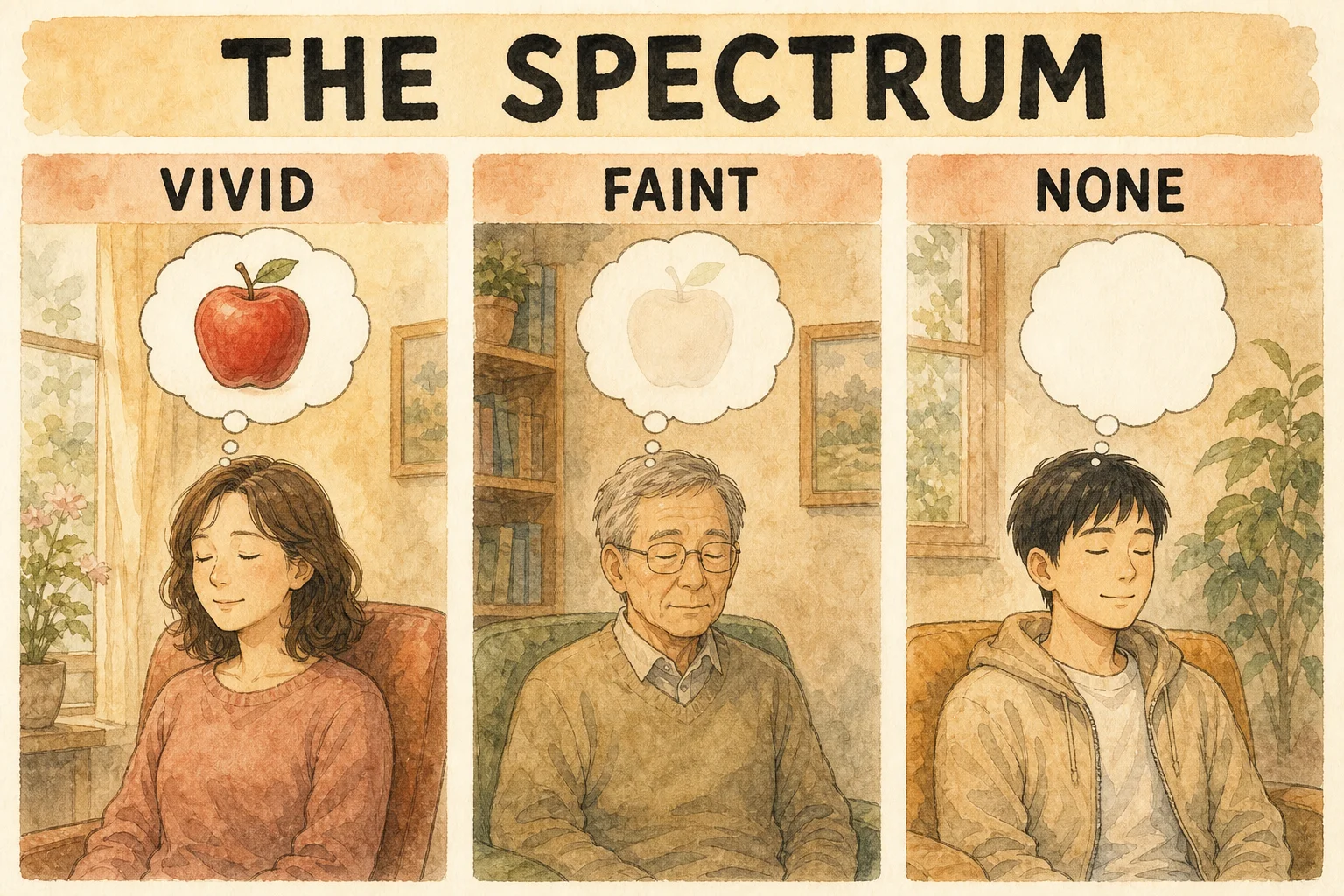
The apple test
The quickest way to see where you sit: close your eyes and picture an apple.

People with hyperphantasia see something close to a real apple. Most people see something in between. People with aphantasia see nothing at all. They know what an apple is, and they can tell you its color, shape, and taste, but no picture appears.
This version counts up from 1 (nothing) to 5 (vivid), the same direction as the formal questionnaire. Some versions that circulate online count the other way, which is why the author John Green once posted that he was "such a total 5 on this scale I didn't know 1-4 existed." (John Green on X, 2023)
The apple test is a casual self-check, not a diagnosis. For a more careful measure, try the free 16-question VVIQ test from the Aphantasia Network.
It is not only pictures
Imagination happens in every sense. Can you hear a song in your head? Smell coffee that is not there? Feel sand under your feet?

Some people with aphantasia lack only visual imagery. Others lack imagery in every sense, which people in the community call multisensory aphantasia. In the 2015 paper that named aphantasia, about half the participants said all their senses were affected. (Zeman et al., 2015) Later research found that people with aphantasia tend to report less imagery in other senses too, though not everyone lacks it completely. (Dawes et al., 2020)
The neighbors
A few related differences often show up alongside aphantasia. They are separate things, and any one person may have some, all, or none of them.
- Hyperphantasia. The opposite end: imagery as vivid as real seeing. Roughly 3% of people. (Exeter, 2024)
- Anauralia. No auditory imagery: a quiet "mind's ear." People who cannot picture things often cannot "hear" things either. (Hinwar & Lambert, 2021)
- Anendophasia. Little or no inner speech: no voice narrating your thoughts. The term was proposed in 2024. (Nedergaard & Lupyan, 2024) Not everyone with aphantasia has this. I do.
- SDAM, severely deficient autobiographical memory. Knowing the facts of your life without being able to re-experience it. You know you went to the beach as a kid, but you cannot relive being there. (Palombo et al., 2015) Many people with aphantasia report thinner memories of their own past.
Dreams
Many people with aphantasia still dream in pictures. In the original 2015 study, 17 of the 21 participants did. Their dreams do tend to be less visually detailed on average, and some people with aphantasia report no visual dreams at all. (Dawes et al., 2020)
Born this way, or changed
Most people with aphantasia were born with it. This is called congenital aphantasia. Less often, someone loses their imagery after a brain injury or illness, or during a period of severe psychological stress. This is called acquired aphantasia. (Aphantasia Network overview) If your imagery changes suddenly, talk to a doctor.
Where I sit
For the record: I am at 1 on the apple scale. I have no mind's eye and no inner monologue, and my memory of my own life is thin. I cannot imagine anything in any sense: no pictures, sounds, smells, tastes, touch, or movement. That is the far end of the spectrum, and I have come to love it. The inside view is in What It Is Like.