You Are Not Broken
Aphantasia is not a disease, not a disorder you need to fix, and not a verdict on your intelligence or your heart. It is a way a mind can be made.
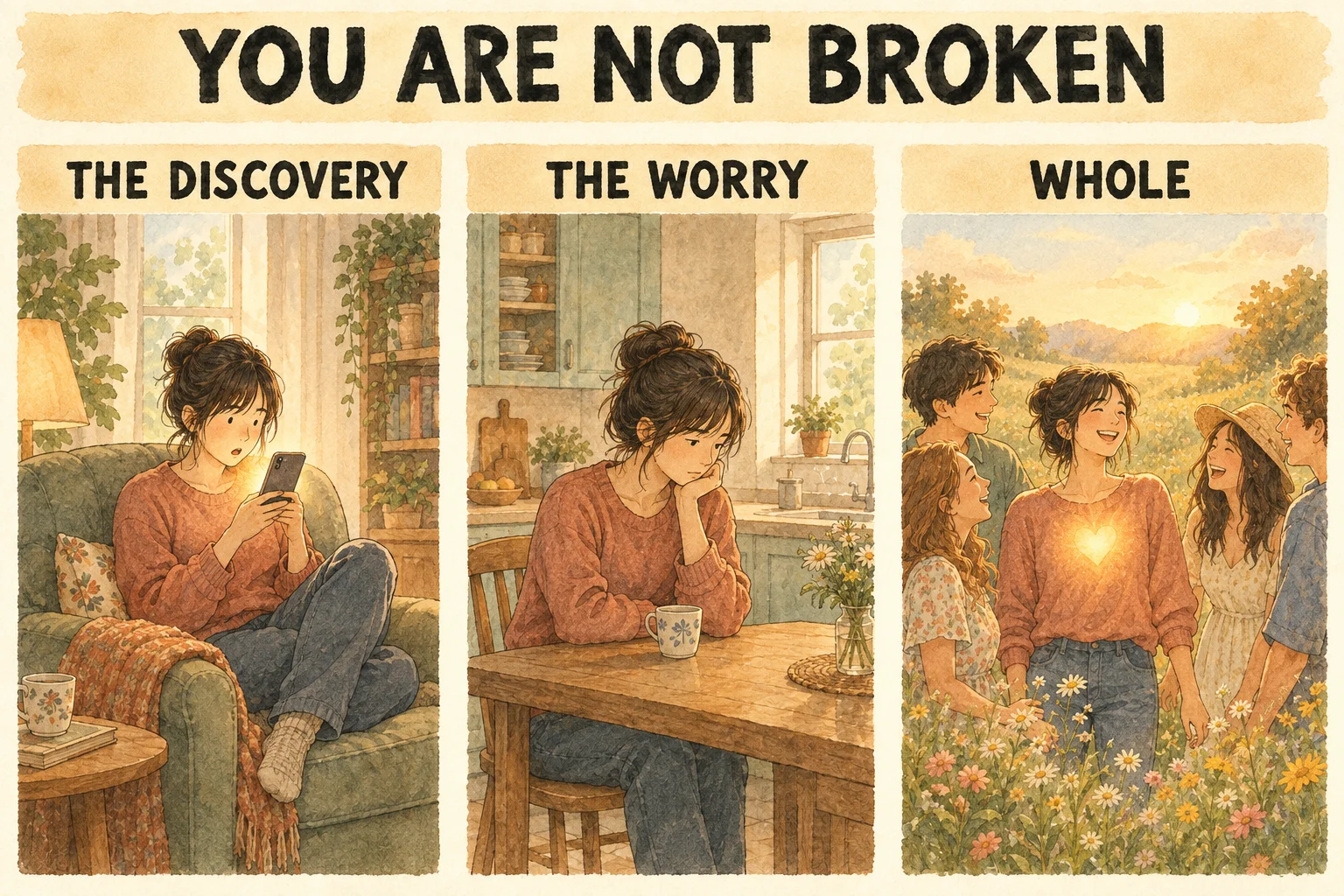
If you just found out
Many people find out the way I did: someone says "picture this" and means it literally, and suddenly you realize the rest of the world has been describing something you never had.
The first feeling can be a strange mix. Relief, because a lot of things finally make sense. And grief, because it can feel like you have been missing something your whole life.
Both feelings are okay. Here are a few things I wish someone had told me.
Nothing has changed except the name
You are the same person you were yesterday. Your mind worked this way long before you had a word for it, and it carried you here. The friendships you built, the things you learned, the love you feel for people: all of it happened with this exact mind. Finding the word does not take anything away. It gives you a way to understand yourself and explain yourself to the people you love.
It is common, and it is not an illness
Aphantasia is not a disease and is not listed as a mental disorder. Most people who have it were simply born this way. Researchers estimate that about one person in a hundred has no visual imagery at all, and three or four more in a hundred have only very faint imagery. See Where the Word Came From for the numbers and their sources.
If you ever lose your mental imagery suddenly, after an injury, an illness, or a period of severe stress, that is different, and it is worth talking to a doctor.
You are probably not missing what you think
People with aphantasia still think, remember, love, create, and dream big. Many are scientists, engineers, writers, and artists, including some of the most celebrated in their fields (see People With Aphantasia). A lot of what other people do with pictures, you already do another way: with concepts, with feeling, with words, with systems, with the heart.
And there are gifts that come with it. For me: letting go easily, forgiving easily, not being haunted by replayed moments, and staying present. See Moving On.
A few practical things that help
- Write things down, or just say them. If memory is thin, a record is a gift you give your future self, and voice transcription makes it almost effortless. See Hyper-Documenting.
- Take pictures and keep them. Photos hold the details your mind does not.
- Tell the people close to you. It explains a lot of small misunderstandings, like why you do not remember what someone wore or cannot "picture" the plan.
- Ask the people you love how their minds work. You will be amazed. Start with these questions.
You were made this way on purpose
I believe God made your mind exactly this way, and that He did not make a mistake. "I will praise thee; for I am fearfully and wonderfully made" (Psalm 139:14). You are not a broken version of someone else. You are one of the many ways He shows His creativity.